
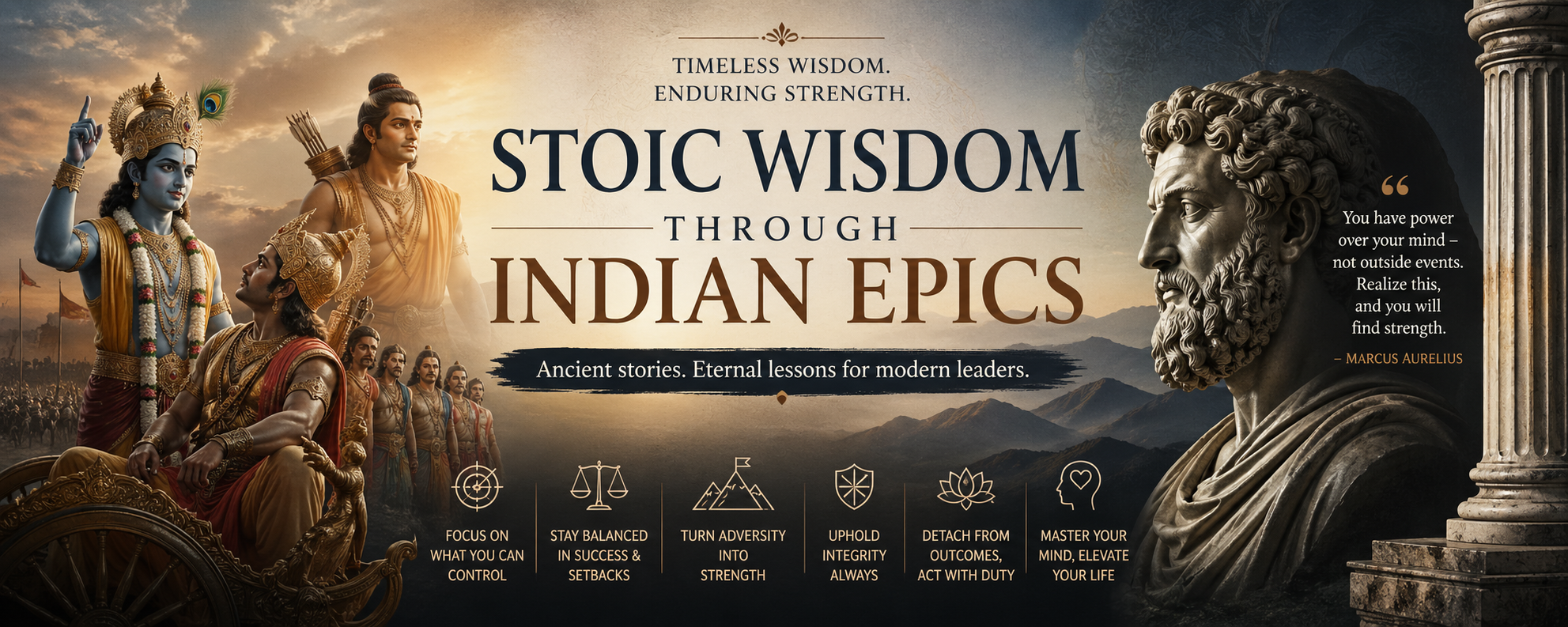

In recent years, Stoic philosophy has gained renewed attention among leaders and professionals seeking clarity, emotional strength, and resilience.
Thinkers like Marcus Aurelius, Epictetus, and Seneca taught powerful ideas about mastering emotions, accepting reality, and focusing on purposeful action.
Interestingly, many of these Stoic principles are deeply reflected in Indian epics such as the Mahabharata, Ramayana, and the philosophical dialogue of the Bhagavad Gita.
When we connect Stoic ideas to these familiar stories, they become vivid, memorable, and highly practical—especially for leaders navigating uncertainty and responsibility.
1. Focus on What You Can Control — The Lesson of Arjuna
One of the central Stoic teachings is simple yet powerful: Focus on what is within your control, and accept what is not.
In the Bhagavad Gita, the warrior Arjuna stands on the battlefield, overwhelmed by doubt and emotional conflict. He questions whether he should fight at all.
At that moment, Krishna reminds him of a timeless truth: You cannot control outcomes. You cannot control others. But you can control your actions and your commitment to duty.
For leaders today, this translates into:
- Focus on preparation
- Focus on decisions
- Focus on effort
Leave outcomes to unfold.
Leadership Insight: Clarity comes when we shift attention from results to responsibility.
2. Stay Balanced in Success and Setbacks — The Example of Rama
Stoic philosophy emphasizes emotional steadiness regardless of external circumstances.
A profound example appears in the Ramayana.
When Rama was about to be crowned king, he accepted the honour calmly. When he was suddenly exiled to the forest for 14 years, he accepted that with the same composure.
No resentment. No bitterness. No dramatic reaction. Just acceptance and forward movement.
In professional life, roles change, projects fail, promotions are delayed, and plans shift.
Leadership Insight: Emotional balance builds credibility and trust.
3. Use Adversity as Preparation — The Pandavas in Exile
Stoics believed that adversity is not punishment—it is preparation.
The exile of the Pandavas in the Mahabharata illustrates this beautifully.
After losing their kingdom, they faced hardship, uncertainty, and humiliation. Yet they did not waste their time in complaint or self-pity.
Instead, they:
- Strengthened their skills
- Built alliances
- Developed patience
- Prepared mentally
Years later, that preparation became their strength.
In modern workplaces, setbacks often become turning points—if used wisely.
Leadership Insight: Difficult periods are often disguised training grounds.
4. Uphold Integrity — Even When It Is Difficult
Stoicism places virtue above convenience.
A powerful example is Yudhishthira from the Mahabharata.
He was known for his unwavering commitment to truth, even under pressure. While circumstances tested him repeatedly, his identity remained anchored in values rather than temporary advantage.
In leadership roles, integrity is tested in moments of ambiguity—not clarity.
Leadership Insight: Character is built through consistent alignment between values and action.
5. Accept Reality with Dignity — Bhishma’s Final Strength
Acceptance is a core Stoic discipline.
Few examples capture this better than Bhishma lying on the bed of arrows in the Mahabharata.
Despite immense suffering, he did not resist reality or complain about fate. Instead, he used his remaining time to teach wisdom and guide future generations.
This reflects the Stoic idea:
When circumstances cannot be changed, wisdom lies in how we respond.
Leadership Insight: Dignity under pressure inspires lasting respect.
6. Detachment from Outcomes — The Wisdom of Karma Yoga
Perhaps the most direct bridge between Stoicism and Indian philosophy lies in the teaching of detached action.
In the Bhagavad Gita, Krishna teaches: Perform your duty with dedication, but do not attach your identity to results.
This mirrors Stoic thinking: Effort belongs to you. Outcome belongs to circumstances.
In corporate environments, over-attachment to results often creates anxiety, burnout, and reactive decision-making.
Leadership Insight: Detached effort produces consistent performance and mental clarity.
7. Transform Self-Doubt into Confidence — Hanuman’s Leap
Stoicism is not about suppressing emotions—it is about guiding them.
Before leaping across the ocean in the Ramayana, Hanuman briefly doubted his abilities.
Through encouragement and reflection, he rediscovered his strength.
He did not deny fear— He moved beyond it.
In professional life, even capable individuals experience moments of hesitation.
Leadership Insight: Confidence is often rediscovered, not created.
Why These Stories Matter for Modern Leaders
Ancient epics were never just stories—they were frameworks for thinking, decision-making, and leadership.
Stoic philosophy and Indian epics converge on shared principles:
- Emotional balance
- Duty-driven action
- Resilience under pressure
- Acceptance of reality
- Commitment to values
These are not abstract ideals—they are daily leadership practices.
In a world of constant uncertainty, leaders who internalize these principles demonstrate:
- Calm under pressure
- Clarity in decisions
- Strength during adversity
- Stability during change
A Closing Reflection
Modern leadership challenges may look different from ancient battlefields, but the inner struggles remain remarkably similar.
Confusion, pressure, uncertainty, responsibility—these are timeless human experiences.
The wisdom found in the Mahabharata, Ramayana, and the Bhagavad Gita continues to echo the principles taught by Stoic philosophers like Marcus Aurelius and Epictetus.
Different civilizations. Same wisdom. Same human journey.
Invitation to Reflect
Which story from Indian epics has shaped your thinking or leadership approach?
Share your reflections in the comments—your insight may inspire someone else’s journey.
#Stoicism #LeadershipWisdom #IndianEpics #EmotionalResilience #LeadershipDevelopment #AncientWisdom #ModernLeadership #BhagavadGita #Mahabharata #Ramayana