
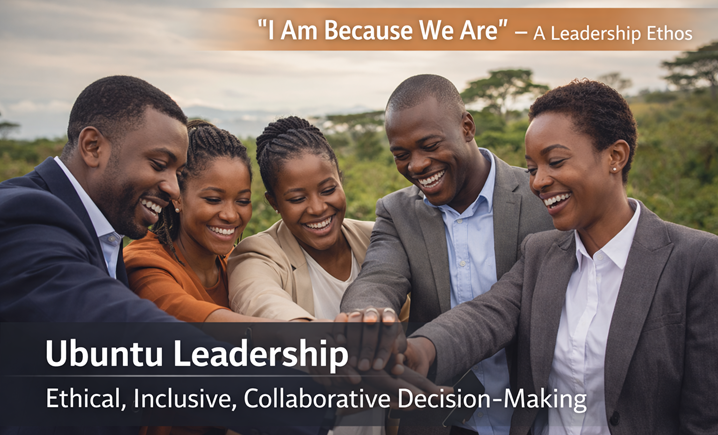

“I Am Because We Are” — A Leadership Philosophy the Modern Workplace Needs
In an era defined by rapid change, digital transformation, and increasing workplace diversity, leadership is no longer about authority alone—it is about connection. The African philosophy of Ubuntu, meaning “I am because we are,” offers leaders a timeless yet highly practical framework for ethical, inclusive, and collaborative decision-making.
Ubuntu leadership shifts the focus from individual success to collective wellbeing. It reminds leaders that their strength lies not in standing above people, but in standing with them.
Organizations that adopt Ubuntu principles often discover that collaboration improves, trust deepens, and productivity becomes sustainable rather than forced.
Understanding Ubuntu in Leadership
Ubuntu is built on the belief that an individual’s success is inseparable from the wellbeing of the community. In leadership, this philosophy encourages decisions that balance performance with people-centered values.
Ubuntu leadership emphasizes:
- Ethical decision-making
- Inclusivity and fairness
- Collective accountability
- Shared success
- Human dignity in the workplace
When leaders embrace Ubuntu, they recognize that organizational growth is not just about profits—it is about people thriving together.
Why Ubuntu Leadership Matters Today
Modern workplaces face increasing challenges:
- Employee disengagement
- Cultural differences within teams
- Trust deficits between management and employees
- Competition replacing collaboration
Traditional hierarchical leadership models often struggle to address these challenges because they prioritize authority over empathy.
Ubuntu leadership offers an alternative: Leadership through humanity.
This approach fosters environments where people feel respected, heard, and valued—conditions essential for high-performing teams.
Applications of Ubuntu in Leadership
- Ethical Decision-Making Rooted in Collective Welfare
Ubuntu leadership encourages leaders to think beyond immediate gains and consider the broader impact of decisions on people and communities.
Rather than asking:
“What benefits the organization alone?”
Ubuntu leaders ask:
“What benefits the organization and its people together?”
Leadership Practice:
- Evaluate decisions based on fairness and long-term impact.
- Consider employee wellbeing alongside business performance.
Result:
Decisions gain credibility because they reflect integrity and responsibility.
Ethics builds trust—and trust sustains organizations.
- Inclusive Leadership That Values Every Voice
Ubuntu leaders believe every individual matters.
Inclusivity under Ubuntu is not symbolic—it is operational.
Team members are encouraged to participate in discussions, contribute ideas, and express concerns without fear.
Leadership Practice:
- Encourage open dialogue across levels.
- Seek perspectives from diverse team members before making major decisions.
Result:
Employees feel ownership of outcomes, not just responsibility for tasks.
Ownership strengthens engagement.
- Collaborative Decision-Making That Strengthens Bonds
Ubuntu leadership replaces isolated decision-making with collaborative thinking.
When leaders invite participation, they create alignment rather than resistance.
Collaboration transforms employees into partners.
Leadership Practice:
- Conduct group problem-solving sessions.
- Encourage teams to co-create solutions.
Result:
Decisions become stronger because they reflect collective wisdom.
Collective wisdom reduces errors.
- Building Trust Through Shared Accountability
Ubuntu teaches that responsibility is shared.
Instead of assigning blame, Ubuntu leaders foster accountability through support and collective ownership.
Leadership Practice:
- Frame challenges as team responsibilities rather than individual failures.
- Recognize contributions collectively.
Result:
Teams support each other rather than compete internally.
Support builds cohesion.
Ubuntu Leadership and Organizational Culture
Culture is shaped not by policies—but by leadership behavior.
Ubuntu leadership fosters cultures where:
- Respect is mutual
- Diversity is celebrated
- Collaboration is natural
- Ethical behavior is expected
- Success is shared
Such cultures create psychological safety, allowing employees to contribute their best ideas.
When people feel respected, they contribute with confidence.
Confidence drives performance.
The Productivity Advantage of Ubuntu Leadership
Ubuntu leadership enhances productivity through human-centered practices.
- Stronger Relationships
Teams that trust each other communicate more effectively.
Better communication reduces errors.
- Higher Engagement
Employees who feel included invest emotionally in their work.
Emotional investment drives consistent effort.
- Reduced Conflict
Ubuntu encourages empathy and understanding.
Empathy reduces workplace friction.
- Sustainable Performance
Short-term performance may be achieved through pressure.
Long-term performance requires connection.
Ubuntu builds that connection.
Ubuntu Leadership in Action: Practical Daily Practices
Leaders can integrate Ubuntu into everyday leadership through simple yet powerful habits:
- Begin meetings by inviting input from all participants.
- Recognize team contributions publicly.
- Encourage peer collaboration rather than individual competition.
- Address conflicts through dialogue rather than directives.
- Celebrate collective achievements.
Small actions reinforce big values.
And values shape culture.
Ubuntu and the Future of Leadership
The future of leadership will not be defined solely by strategy—but by humanity.
Organizations operating in diverse, global environments require leaders who understand relationships, empathy, and collaboration.
Ubuntu leadership prepares organizations to thrive in such environments because it aligns business goals with human dignity.
In Ubuntu leadership:
Success is shared.
Responsibility is shared.
Growth is shared.
And shared success is sustainable success.
Closing Thought
Leadership is not about standing alone at the top.
It is about lifting others so the entire organization rises.
Ubuntu reminds us that leadership is fundamentally relational.
When leaders care for people, people care for results.
That is the enduring power of Ubuntu leadership.